
Inside Jay County Tax Records
Jay County splits its property tax records between two offices. The Jay County Assessor keeps the parcel assessment side. That covers the value feeding the tax system and the owner label shown on the public platform. Bills are a different lane. The Jay County Treasurer collects payments, applies penalties, and moves delinquent parcels toward tax sale. The Auditor works in between. Recorded transfers, deductions, and tax-roll certification all pass through that office. Knowing each role keeps a paid bill from being mistaken for proof of value or ownership.
| Field | What It Shows | Where |
|---|---|---|
| Gross assessed value | Market value-in-use before deductions | Assessor roll |
| Net assessed value | Value remaining after applicable deductions | Assessment and tax data |
| Deductions | Adjustments applied before the bill is calculated | Auditor and assessment record |
| Tax bill and status | Installments, amount due, payment, or delinquency | Treasurer |
| Tax district and rate | Local rate applied per $100 of net assessed value | Tax record |
Indiana assesses real property at 100 percent of market value-in-use. Annual trending is drawn from sales. That standard comes with a catch. A home may not sell for its assessed amount. A recorded sale price is a transfer fact, nothing more. The tax bill, by contrast, layers deductions and the local rate onto the assessment. The dedicated Jay County property value explanation keeps those numbers distinct. It does not pretend to compute your tax.
Jay County Assessment Search Modes
The Schneider platform linked from the county offers several routes to the same Jay County property tax record. Start with the address. When the street fails, Indiana DLGF suggests dropping the direction or the street type. An owner search helps when an address has changed. Once found, a parcel ID is the strongest key.
| Search mode | Best input | Useful retry |
|---|---|---|
| Search all | A broad known term | Switch to a focused mode |
| Search by name | Owner or entity name | Use a partial last name |
| Search by address | Situs street address | Omit direction and street type |
| Search by parcel ID | Full APN with punctuation | Copy it from the prior result |
| Search by alternate ID | Alternate tax reference | Use the exact displayed value |
The public platform's result card displays fields such as Parcel, Alternate ID, Address, Ownership, City, ASV, and several reference columns. No field-by-field manual exists. Jay County also publishes no refresh calendar. The Assessor can confirm anything unclear. For the entry point, the Schneider/qPublic search screen is the page that routes visitors into county assessment data.
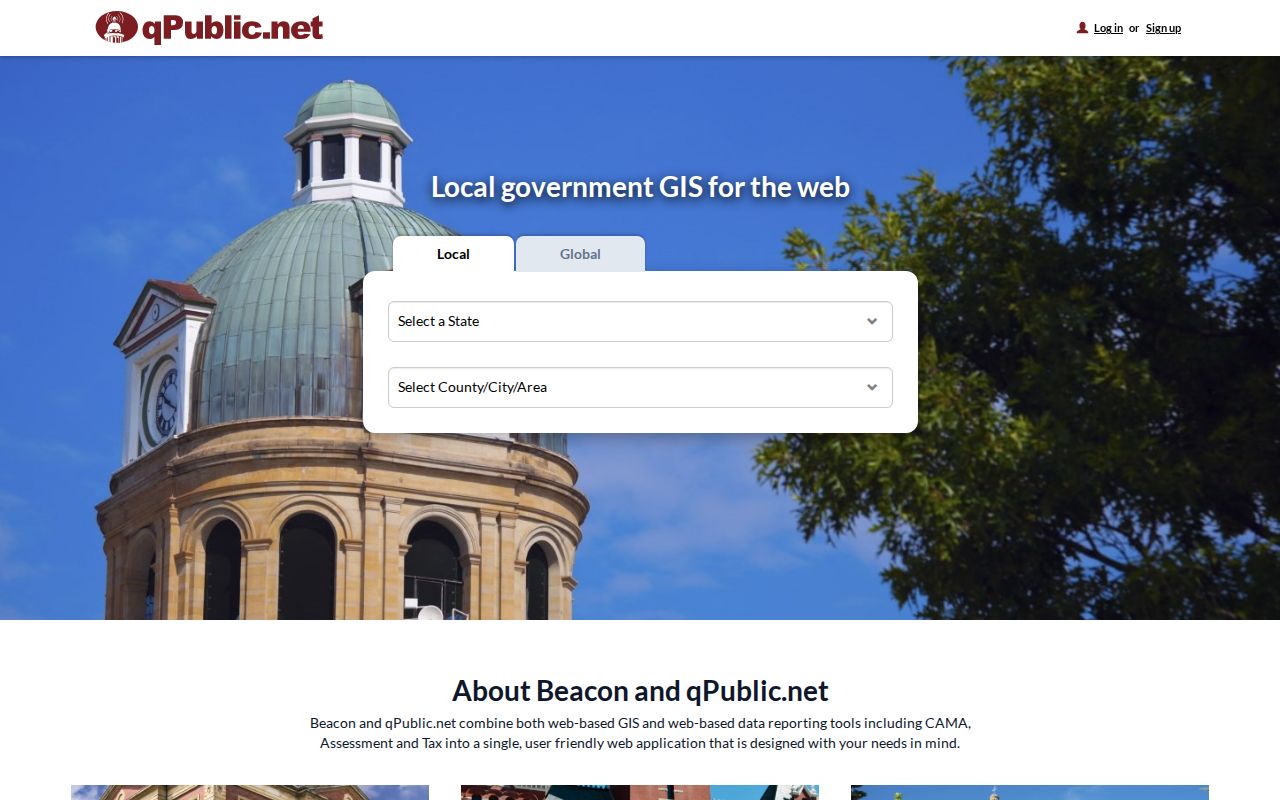
Treat its mode choices as search tools, not final answers. If the live card looks incomplete, verify the parcel-specific result with the Jay County Assessor.
Trace a Jay County Tax Bill
A tax bill lookup starts with the parcel, not a name. The Assessor search yields the parcel ID and assessed value; the Treasurer's route shows what was billed and paid. Keep the number whole. Hyphens and any decimal portion matter. Jay County identifiers run long and punctuated, and the county publishes no segment-by-segment guide for decoding them. Copying the key beats parsing it.
- Search the county-linked Beacon or Schneider record by situs address. Copy the parcel and alternate ID exactly.
- Compare the gross and net assessed values. Note deductions before moving to the bill.
- Follow the Treasurer's Beacon payment path and identify the current installment, payment status, and any penalty.
- Call the Treasurer when an old balance, posting delay, or delinquency status is unclear. Do not infer a tax lien from an unpaid-looking screen alone.
- Assessed value
- The value set under Indiana's market value-in-use rules.
- Tax rate or levy
- The local rate applied per $100 of net assessed value.
- Homestead deduction
- A deduction associated with a qualifying principal residence; eligibility belongs with the Auditor.
- Tax lien
- A legal claim tied to unpaid property tax, not merely a late online display.
The Treasurer takes payment several ways. Options include online, by mail, at the office, through a south-side drop box, and at First Bank of Berne or Farmers & Merchants State Bank. Mailed payments need a postmark by the due date. Card payments carry a 2.5 percent fee. An eCheck costs $2. The Jay County Treasurer page posts the current payment routes and dates.
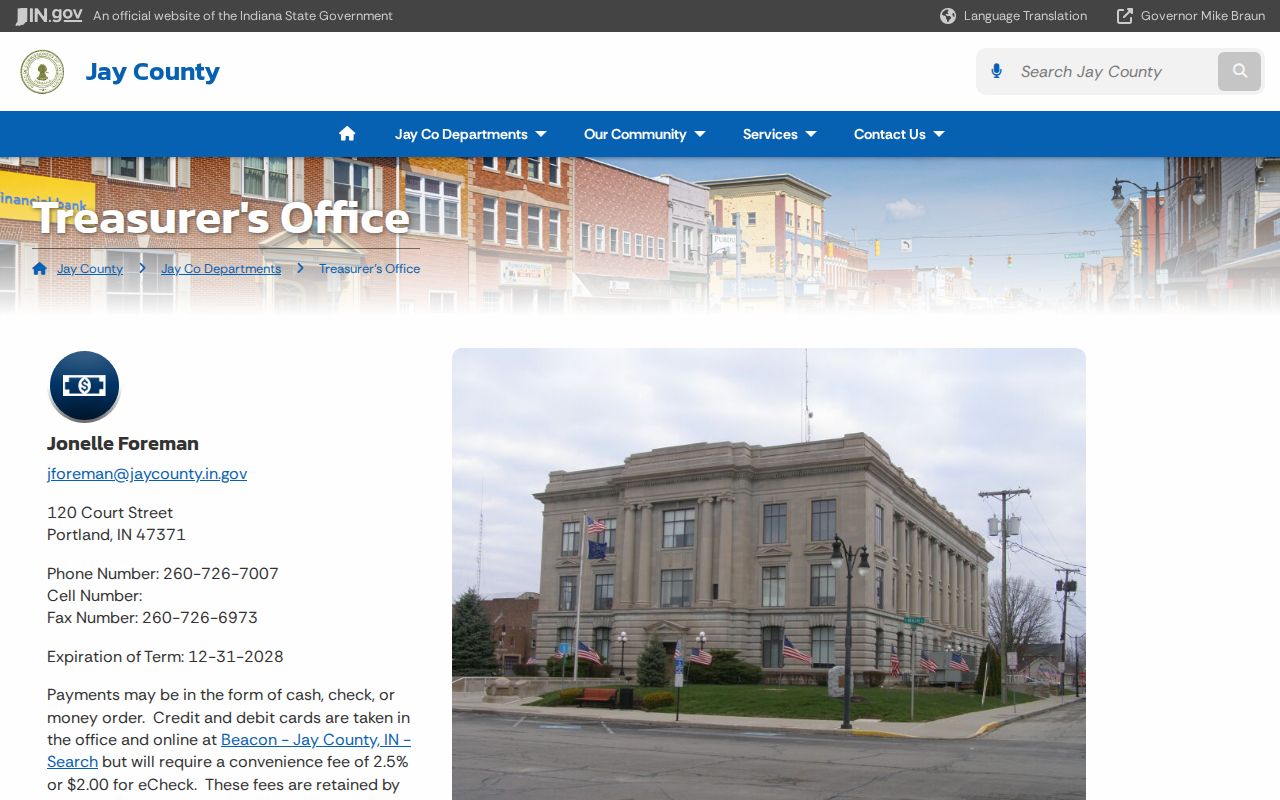
Deadlines, bank routes, and online availability all change, so check that page before paying.
Jay County Tax Dates
For 2026, Jay County lists a spring installment due May 11 and a fall installment due November 10. Online payments stop at midnight on those dates. That matters near the cutoff. An online option may not survive the night. Mailed payments ride on the postmark, per the county's published instructions. If a payment lands oddly, the Treasurer can confirm whether a bank, drop-box, or electronic payment posted to the right parcel. Save the receipt with the parcel ID. A receipt proves payment activity, not ownership or a legal boundary.
Note: Confirm the tax year and installment before paying, especially when the same owner has more than one parcel.
Jay County Deductions and Transfers
The Auditor sits at the center of Jay County's transfer and deduction work. A published fee schedule lists $10 per parcel for a deed transfer. It also shows a $20 disclosure fee. These are administrative charges that follow a conveyance. Keep them separate from the Recorder's deed fee or the Treasurer's tax payment.
Timing is where new owners get tangled. The recorded deed date, the assessor's Ownership field, deductions on the assessment, and the name on the tax bill can each lag behind the others. Jay County publishes no exact roll schedule. So call the Assessor at 260-726-4456 or the Auditor at 260-726-7575 when a transfer or deduction fails to show up. The second sentence was left intact per the instruction to change nothing else.
Jay County's 2026 Value Cycle
Indiana starts its next statewide cyclical reassessment on July 1, 2026. Those assessments apply to 2026 pay 2027 taxes. The DLGF reassessment schedule sets a four-year cycle. Roughly 25 percent of parcels get physically inspected each year. Jay County has released no neighborhood-by-neighborhood order for the inspections.
Neighbors can end up with different assessment years. Not every Jay County property tax record changes that day. Trending still continues. The inspection cycle adds one input to valuation work. Ask the Assessor whether a parcel sits in this year's group; a neighbor's value will not answer that. The Indiana DLGF assessed-value search also offers statewide guidance and download options.
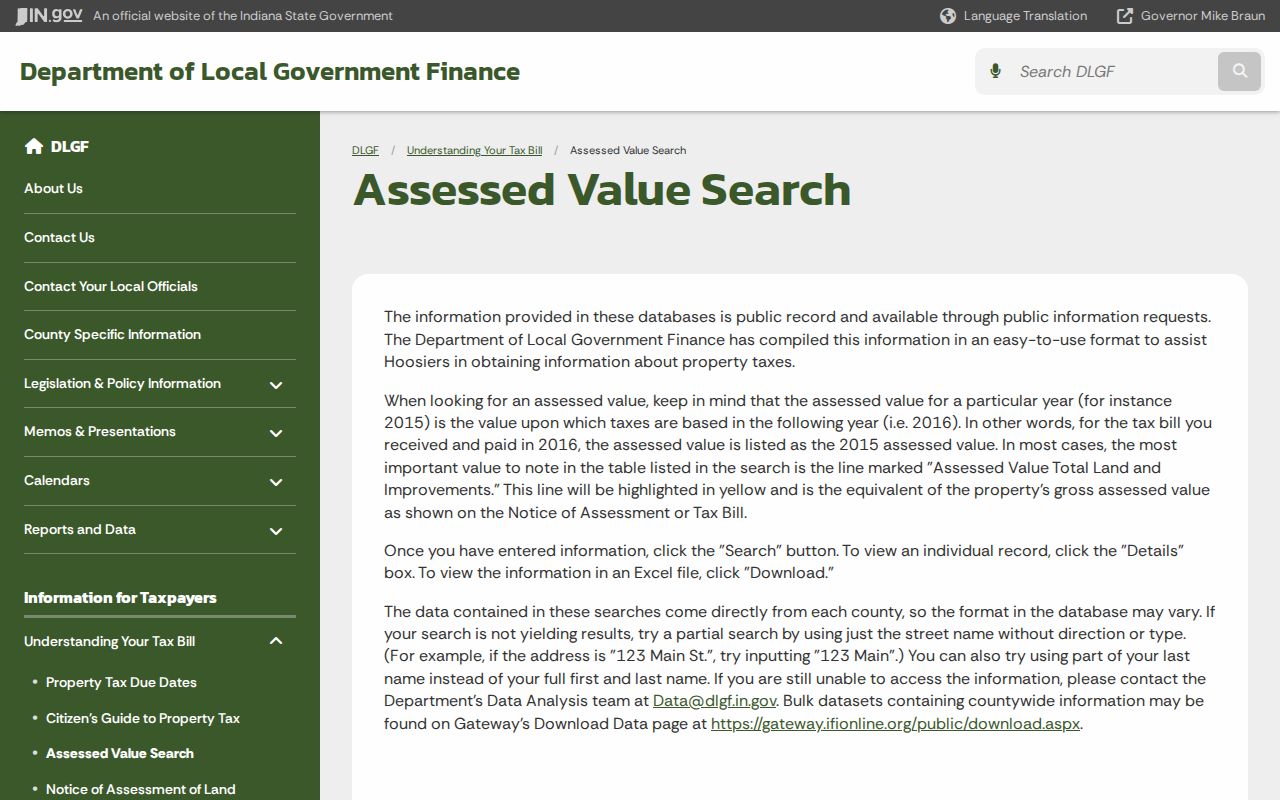
The state view makes a handy second route. For a disputed local entry, though, Jay County's own offices remain the custodians of the record.
Jay County Delinquent Tax Trail
A delinquent parcel leaves tracks across several public records. Start with the Treasurer's balance. Then trace tax-sale notices, county meeting minutes, and later Recorder filings. A 2025 Jay County legal notice listed 95 tax-sale properties. Commissioners' minutes also documented a certificate acquired in 2024 for a Dunkirk parcel. Treat these as stages in a process, not proof that the named parcel now carries a tax deed.
A tax-sale certificate is not a deed. Redemption may follow, along with possible tax-deed proceedings, a court action, and later Recorder or assessor updates. The Treasurer or Auditor can confirm present status. The Recorder holds the final instrument. When a nonconfidential list or administrative record is not posted online, Indiana APRA allows a targeted request to the office holding it.
Contest a Jay County Assessment
An appeal challenges value, not tax-bill arithmetic. Indiana's citizen tax guidance sends owners to the county assessor first, then into the formal appeal process. Form 130 is the taxpayer notice that opens an appeal. Jay County posts no current copy online. Get the form and its filing instructions straight from the Assessor before trusting an old download.
Good support includes a recent property record card and photographs. A corrected land or improvement description helps too. Comparable sales can add weight. So can a professional appraisal. The notice date controls the filing period. Indiana's general deadlines tie to a notice date or May 10, depending on how the assessment was issued. The Assessor should confirm the exact deadline for the parcel.
Protect the appeal date. Ask the Jay County Assessor which deadline applies to the notice, then file the current form with proof of delivery.
Offline Jay County Tax Access
Walking into the courthouse still works. The Jay County Assessor sits on the first floor and answers parcel-card questions by phone at 260-726-4456. The Treasurer takes calls at 260-726-7007 and receives mail at 120 N Court St., Suite 203, Portland, Indiana 47371. For the Auditor, dial 260-726-7575. Hours can differ from the Recorder's posted schedule, so confirm counter times before you drive over.
When a record never made it online, file a focused public records request. Indiana's Access to Public Records Act asks agencies to respond within 24 hours to a phone or in-person request and within seven calendar days to mail, email, or fax. Name the parcel, the tax year, and the record type to keep the request tight. Production can take a reasonable time after that. If access is denied, ask for the exemption in writing.
Older ownership and land context is a different trail. The Indiana State Library's Jay County guide, microfilm, and historical maps can explain how an old parcel took shape. The current tax balance, though, still comes straight from Jay County.