
Deed Types in Jay County Records
The Jay County Recorder keeps every instrument that touches land. The deed type tells you the context of a transfer. It might mark a sale, a gift, or a correction. Still, the recorded language itself controls. Pull the parties, the execution and recording dates, and the legal description. Note any reservations. Then grab the book and page or instrument reference for each deed you handle.
| Deed Type | What It Does | Common Use |
|---|---|---|
| Warranty deed | Transfers title with stated covenants | Ordinary sale |
| Quitclaim deed | Transfers the interest held, if any | Family or title cleanup |
| Trustee or representative deed | Transfers through a formal role | Trust or estate administration |
| Sheriff deed | Follows judicial sale procedure | Foreclosure trail |
| Tax deed | Follows statutory tax-sale steps | Delinquent-tax property |
Not every instrument sells land. A mortgage or lien can burden a parcel while the owner of record stays the same, and a release later marks the debt satisfied. Read the deed records with that in mind. Search by name and legal description together rather than treating each indexed entry as a transfer of title.
Follow Jay County Grantors and Grantees
Start with the Doxpop Recorder search. It is the online index entry point for Jay County deed records. The public form accepts a party name and region. Advanced options open up date ranges, document types, platted or unplatted land, and legal-description terms. Jay County index entries and scanned images reach back to January 1997.
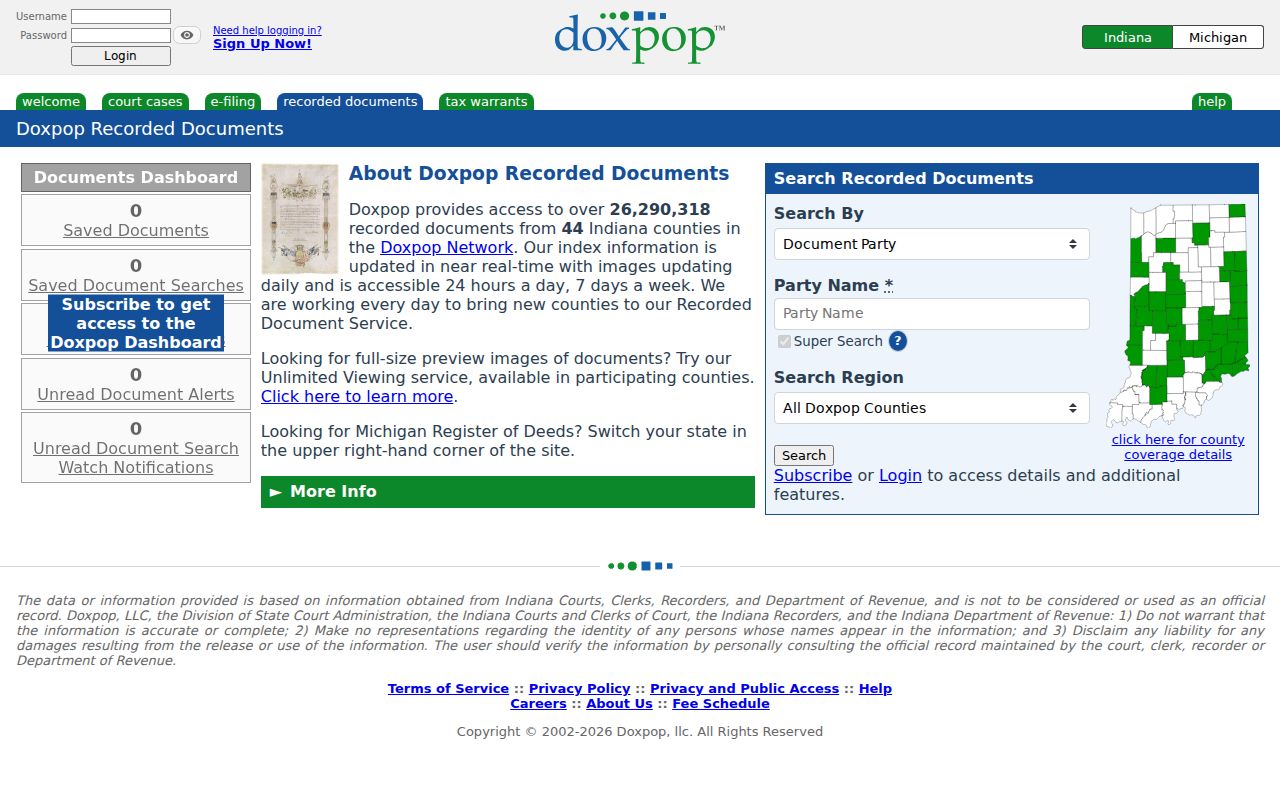
That online screen covers the modern era. For the chain of title before 1997, turn to the older deed books and microfilm held locally and at the State Library.
- Find the current owner's acquisition deed, with that owner as grantee.
- Read the grantor, legal description, recording date, and reference.
- Search that grantor as an earlier grantee and narrow the date range.
- Repeat until the chain crosses the online boundary, then use deed books.
- Grantor
- The party transferring an interest.
- Grantee
- The party receiving an interest.
- Chain of title
- The linked sequence of transfers for the same land.
- Book/page
- A volume and page retrieval reference.
Jay County's 1997 Access Divide
Doxpop's partner table lists index and image coverage starting in January 1997. Treat that as an online boundary, not the start of Jay County deeds. The Indiana State Library microfilm finding aid carries land and deed runs from 1836 through 1921. It also holds grantor and grantee indexes through 1901. The State Library Jay County guide adds pointers to original land purchases. It also covers tract books, maps, and probate material. A thin web result is not a dead end. It should send you to the Recorder counter and the older index volumes.
Coverage limit: Online Jay County deed records begin in January 1997. Earlier transfers remain in books, indexes, microfilm, and archives.
Search a Jay County Deed Result
A deed-index result can display the party name, document type, recording date, book and page, document number, and a link to the image. Address text shows up only where it was indexed, so grantor and grantee names plus legal-description clues are safer anchors. When a query tops 500 results, tighten the date span or narrow the instrument class.
| Party name | Grantor, grantee, or another indexed party |
|---|---|
| Document type | Deed, mortgage, release, plat, or other class |
| Recording date | Date accepted by the Recorder |
| Book/page or number | Retrieval key for an image or office copy |
Names rarely stay simple. Trusts, estates, spouses, and business entities may appear under several forms in the deed records. Match the legal description before joining two entries into one chain of title.
Overlapping Jay County Deed Volumes
The microfilm finding aid lists overlapping runs of deed volumes. Examples include volumes H through J covering 1854 to 1857. It also lists J through K covering 1855 to 1859. Lettered volumes do not form one clean timeline. Follow the index and the book and page citation instead of assuming sequence. No reliable account of a Jay County courthouse fire or a destroyed deed decade exists. Coverage limits explain some gaps. Book access, indexing quirks, or probate and sheriff's sales explain most of the rest.
Note: A volume citation is more dependable than choosing a reel solely from the date printed on a later abstract.
Jay County Recorder Copy Options
The Jay County Recorder sits at 120 Court Street, Suite 206, in Portland. The office answers at 260-726-6940. Use the counter, phone, or email when an online image is missing. Try the same routes when a record predates Doxpop. A certified copy call works too. The published fee schedule separates $25 deeds and other instruments. It also lists $55 mortgages, $1 small copies, and $5 certification. Recording charges do not always match the price of an online image. Give staff the exact document reference. Confirm the current copy total before sending payment.
Historic Jay County Land Clues
The State Library catalog lists an 1874 property-owner map for Jay County. It also holds 1881 atlas and plat material. Those sources can link a surname, road, township, or tract to a later deed. The Jay County Public Library Indiana Room adds directories, newspapers, and local histories. The Historical Society does too.
Expect breaks in the chain. Probate, sheriff's, and tax transfers can interrupt a tidy buyer-to-seller sequence. Check the Jay County Clerk's probate record when an owner vanishes from the deed chain. The relevant sale trail may help as well.
Jay County Deed Access Channels
A thorough deed search uses every channel. Doxpop supplies the recent index and images. The Recorder counter pulls local volumes and copies. Phone and email confirm a citation and the current charge before a request goes out. State Library microfilm extends the older trail. The local library and Historical Society help place old names and places.
Make each request specific. Give the grantor or grantee, an approximate recording span, the document type, and any book, page, or instrument number already known. For platted land, include the addition, lot, and block. For unplatted land, quote the legal-description text. That detail cuts the risk of receiving a same-name deed for different land.
Recorded Jay County Plats
Plats sit beside deeds in the Recorder's land records system. A plat shows the recorded layout of lots, blocks, streets, and easements within a subdivision. Later deeds often cite nothing more than an addition name and a lot number. The plat then becomes essential to reading the description correctly.
Municipal approval never replaces county recording. Portland's subdivision rules, for instance, require an approved plat to be filed with the Jay County Recorder. No lot may be sold before that filing. That handoff matters to one transfer. A city planning file and a county plat or deed record can each tell part of it.
Compare details before trusting a match. Check the plat title, the recording reference, the lot, and the block. Each should match the deed itself. Two additions can carry near-identical names. A sloppy match leads to the wrong image. For unplatted land, follow the deed's sectional or metes-and-bounds wording instead.
Note: A recorded plat supplies land-description context, but a current boundary dispute still calls for a survey and deed review.
Jay County Deed Fee Context
The Jay County Recorder separates recording fees from copying fees. Deeds and most other instruments cost $25 to record. Mortgages run $55. Small copies are $1, and certification adds $5. The schedule covers many products. Ask the Recorder to confirm the exact charge before you pay.
Know which service you actually need. A new recording is not the same as a copy. That deed may already be on file. A printout from a portal result is not a certified copy either. Tell staff whether certification is required. They can point you to the right service for your deed records.
Obtain a Jay County Deed Copy
Start with the Doxpop image if one exists. When it does not, contact the Recorder with the names, the recording date, the instrument type, and either the book and page or the document number. A plain copy works for most research. Pay for certification only if the receiving office or the transaction demands it.
For a specific nonconfidential administrative record, a narrow Indiana APRA request can work. This applies when the record falls outside normal copy service. APRA has limits, though. It cannot turn confidential files into public records. It also does not require the Recorder to issue a title opinion.
Recorded, not guaranteed. Jay County deed records show accepted filings. The index is not a title opinion, and unrecorded interests or recording errors may require qualified review.