
Jay County Ownership Trail by Era
Jay County's ownership trail spans two worlds: a modern online index and an older archive of books and microfilm. Begin with the newest source. Then carry each grantor backward, keeping the deed reference intact the whole way.
| Source | Years It Covers | Where Held | What It Shows |
|---|---|---|---|
| Doxpop deed index | January 1997 forward | Online and Recorder | Parties, dates, references, images |
| Deed books and microfilm | 1836 to 1921 runs | Recorder and State Library | Earlier grantors and grantees |
| Historic maps and plats | 1874 and 1881 examples | State Library and Recorder | Owners, tracts, lots, and roads |
| Probate and wills | 1838 to 1968 runs | Clerk and microfilm | Estate authority and transfer clues |
Start with the Doxpop Recorder index for the most recent links in the chain. If the trail runs dry before 1997, take the search to the Recorder counter and the State Library's finding aids.
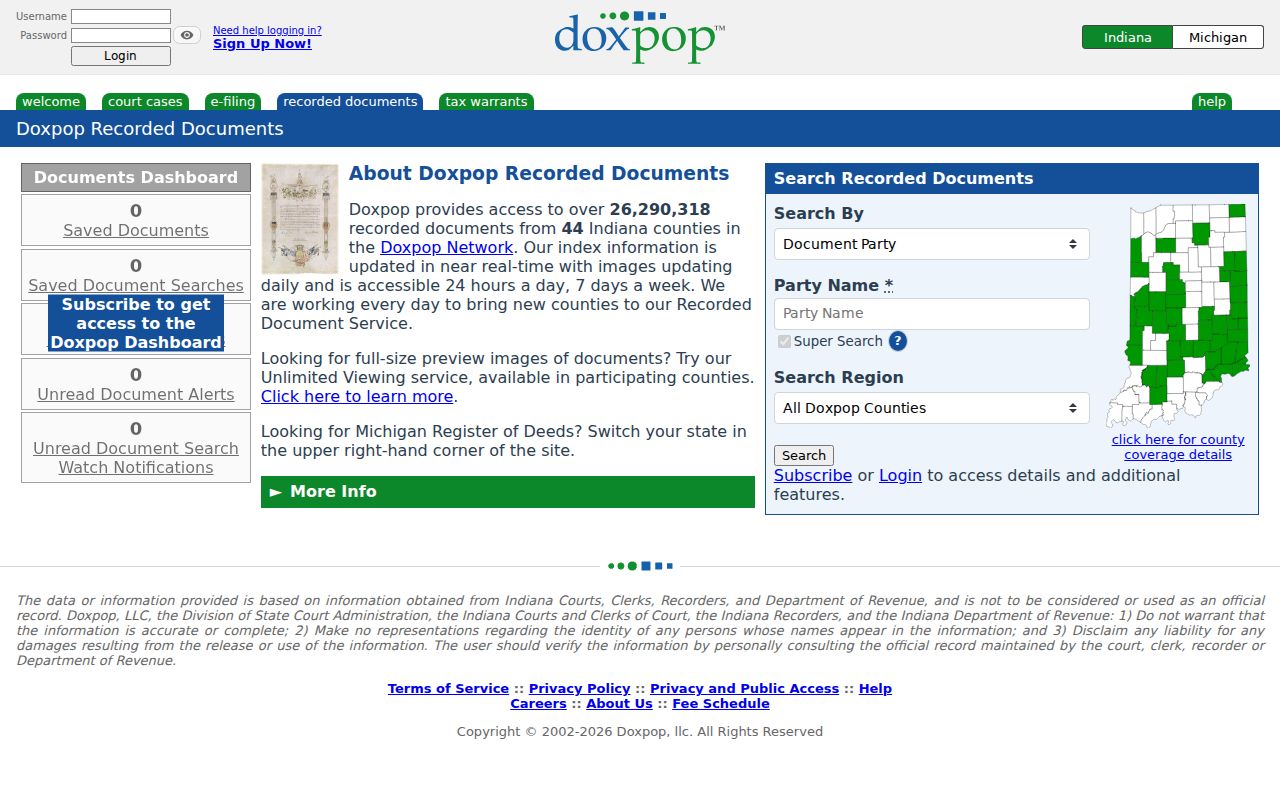
The online index marks the end of the digital timeline. Its book, page, and party references then point the way into older courthouse volumes and microfilm.
Walk Jay County's Chain Backward
The grantor on the current deed is the immediate former owner only when the legal description matches the land in question. Build a dated transfer timeline. Keep every citation along the way.
- Find the current owner's deed with that party as grantee.
- Copy the grantor, date, legal description, and reference.
- Search that grantor as an earlier grantee and confirm the same land.
- Cross the online cutoff with the reverse index, deed book, and microfilm.
- Grantor
- The party transferring an interest.
- Grantee
- The party receiving it.
- Reverse index
- An index used to locate parties in the opposite role.
- Legal description
- The land wording that links old and new deeds.
Jay County's 1997 Divide
Doxpop carries Jay County deed index entries and scanned images from January 1997 forward. That year opens the modern online window. It did not create the land record itself. Earlier owners live in the Recorder's books or on State Library microfilm.
Wait. Before switching media, save the last online book and page citation. That reference bridges into the older grantor and grantee indexes. It also keeps you from restarting the hunt with nothing but a surname.
Overlapping Jay County Volumes
The State Library finding aid lists deed volumes H through J for 1854 to 1857. It also lists J through K for 1855 to 1859. Those spans overlap. A date alone cannot pick the right volume. Follow the index entry and its exact page instead. This is a distinctly local trap. Later abstracts sometimes shorten citations. Compare party names and the legal description before accepting the next former owner.
Probate and Jay County Owners
An estate transfer can snap a simple seller-to-buyer chain. The microfilm finding aid covers probate and will material from 1838 through 1968. An executor, administrator, heir, or estate may appear in the deed index. In that case, search the Jay County Clerk. Probate explains who had authority and how land passed within a family. The recorded fiduciary or distribution deed is what ties the land back into the chain. Keep both citations. Neither one substitutes for the other.
Historic Maps Identify Jay Land
The State Library catalog lists an 1874 property-owner map plus 1881 atlas and plat material. A former surname placed near a road, township, or tract supplies fresh search terms. Take those terms to the deed books. Treat historic maps as clues, not title proof. Use them to settle place names. Then return to the grantor-grantee index and the recorded legal description.
Dunkirk's Older Search Vocabulary
Dunkirk once went by the name Quincy. Its spot on the southwest county line shapes the vocabulary of old records. When a modern-address search fails, retry with Quincy. Also try Dunkirk, Richland Township, nearby county context, and the recorded plat or addition. Place-name history pays off in directories and newspapers. Still, the parcel match rests on deed and plat evidence alone. Never merge two people simply because both lived near the same old town name.
Jay County Former-Owner Access
The Recorder counter is the primary local route to deed books and copies. The Indiana State Library supplies finding aids and microfilm. The Jay County Public Library Indiana Room and the Historical Society add directories, newspapers, maps, and help with older place clues. The Historical Society can help with older place clues. Ask with names, an approximate date, and the last known citation. A narrow request works far better. It beats asking an office to assemble a full title history. Record the source, volume, page, and access date in the transfer timeline as results arrive.
Jay County Sale Transfers
Sheriff and tax-sale records can explain a sudden jump between owners. A notice or certificate is not automatically the final deed. Follow the event through the court or sale record and any redemption. Then trace the later instrument the Recorder filed. A tax-sale certificate marks one stage in a statutory process. Add a former owner to the chain only when the recorded transfer and legal description support it.
Plats Connect Jay County Owners
A subdivision deed may describe land by addition, lot, and block instead of street address. Retrieve the recorded plat. Verify the lot, and compare its citation against each deed. That habit keeps owners of similarly numbered lots apart. Portland shows the city-county handoff at work. Its Plan Commission approves subdivision plats, but the plat must be filed with the Jay County Recorder before lots can be sold.
Directory Clues for Jay Owners
Directories and newspapers can place a person at an address between recorded transfers. They help when a deed lacks a familiar number. Or when house history asks who occupied a place in a given year. Occupancy is not ownership. Confirm a directory name against deeds, tax material, probate, or a plat. The State Library holds Jay directories but no complete year run. Request the specific year you need.
Record the directory title, year, page, exact address, and name spelling. Compare that evidence with the deed timeline. Do not insert it as a transfer. A renter, relative, caretaker, or business could appear at land owned by someone else entirely.
How Far Jay Ownership Goes
Jay County property records online reach back to January 1997. Older deeds survive on paper. The State Library guide and its finding aid trace land and deed material to 1836 and 1837. Grantor and grantee indexes run through 1901. Deed volumes themselves extend through 1921. Volume runs overlap across decades. A book and page citation beats picking a reel by date alone.
The Jay County courthouse suffered no deed-destroying fire. Where a gap appears in the records, work through online coverage, book access, indexing, probate, sheriff sales, and tax transfers. Do not assume records were lost.
Lawful use. Former-owner records support house history, estate work, and property diligence. Never use names or addresses to stalk, harass, threaten, or harm anyone.